
Rosey Grier Net Worth: Biography, NFL Career, Movies & Family
Picture a man who is six feet five inches tall and weighs close to 300 pounds. He spends Sundays wrecking offensive lines for the New York Giants. He wins an NFL championship. He becomes part of a defensive line so intimidating that opponents give it a nickname.
Now picture the same man sitting in a chair with a needle in his hand, stitching a floral canvas, and then writing a book to persuade other men to try it.
That is one person. Roosevelt Grier, known to almost everyone as Rosey.
Most athlete biographies follow a predictable shape. Play, retire, fade, and occasionally appear at a reunion. This one does not. After football he hosted a talk show, guested on roughly 70 television programmes, sang on one of the most influential children’s albums ever made, guarded a presidential candidate, helped disarm that candidate’s assassin, became an ordained minister, founded a nonprofit, and ran briefly for governor of California.
Here’s the thing. Each of those facts on its own would make a decent paragraph in someone’s obituary. Together they make a life that resists easy summary, which is probably why people still search for him decades after his last snap.
This article walks through the whole story. The football, yes, but also the acting, the music, the needlepoint, the ministry, the family, the politics, and the persistent online questions about his net worth. Where the record is solid, it says so plainly. Where sources disagree, it says that too.
Who Was Rosey Grier?
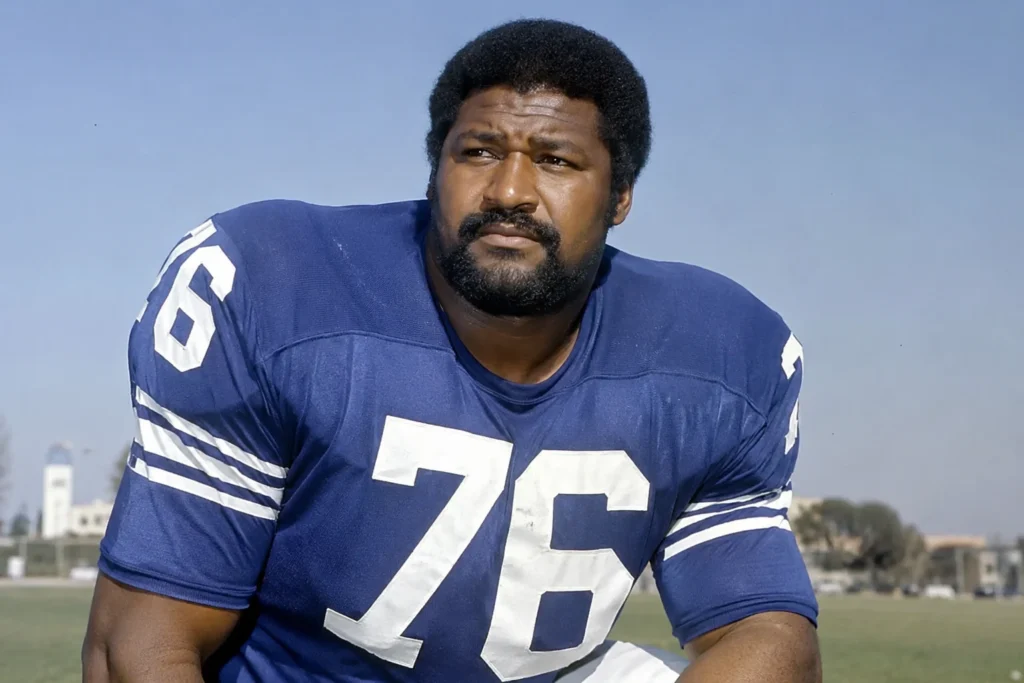
Roosevelt “Rosey” Grier is a former NFL defensive tackle who played for the New York Giants from 1955 to 1962 and the Los Angeles Rams from 1963 to 1966. He was part of the original Fearsome Foursome. After football he became an actor, singer, author, ordained minister and community organiser. He was born on 14 July 1932 in Cuthbert, Georgia, and turned 94 in 2026.
He is best known to football fans for that Rams defensive line. He is best known to a completely different audience for singing “It’s All Right to Cry” and for writing a needlepoint instruction book aimed at men. Both reputations are accurate.
Rosey Grier Quick Facts
| Detail | Information |
|---|---|
| Full Name | Roosevelt “Rosey” Grier |
| Born | 14 July 1932 |
| Birthplace | Cuthbert, Georgia |
| Profession | NFL Player, Actor, Singer, Author, Minister |
| NFL Teams | New York Giants, Los Angeles Rams |
| Position | Defensive Tackle |
| Pro Bowls | 2 |
| NFL Championship | 1956 |
| Famous For | Fearsome Foursome, Acting, Music and Needlepoint |
Early Life and Family Background
Grier was born in Cuthbert, Georgia, one of twelve children. His parents named him after Franklin Delano Roosevelt, who was campaigning for the presidency that same year.
His father farmed sugar cane and peanuts. The children worked the land, and the school was a long walk away, so his early attendance was patchy. By his own account he managed roughly three days a week.
After the Second World War, while he was still in elementary school, the family moved north to Roselle, New Jersey, looking for steadier work. That move changed everything. Regular schooling became possible. So did organised sport.
At Abraham Clark High School in Roselle he grew into a genuine athlete rather than just a big kid. He played both the offensive and defensive line. He also threw the shot put, the discus and the javelin, and he was good enough at all three to attract recruiters. He graduated in 1951.
It’s easy to skip past the track and field part, but it matters. Colleges noticed the combination of size and coordination. That combination shaped the offer that followed.
The Penn State Years
Penn State offered him a track scholarship. He took it, and played football for the Nittany Lions as well.
Under head coach Rip Engle he became a four year starter on the line, playing both ways in an era when that was still common. He captained the track team and won shot put and discus titles at the IC4A championships and the Penn Relays. He earned All-America recognition in track.
He also played through the ugly end of segregation in college sport. Road trips to southern opponents brought open hostility. Teammates from that era have described him as an unusually warm presence on a roster that was navigating all of it.
He earned his degree in 1956. Penn State later gave him its Distinguished Alumni Award in 1974 and named him an Alumni Fellow in 1991. In 2006 the NCAA included him on its list of the 100 most influential student athletes, published for the association’s centenary.
Rosey Grier’s NFL Career
The New York Giants selected him in the third round of the 1955 draft, 31st overall.
The New York Giants Years
He started 85 games for New York between 1955 and 1962. In his second season the Giants won the 1956 NFL Championship, beating the Chicago Bears decisively. That title came a decade before the first Super Bowl, so it sits in the pre merger record rather than the Super Bowl ledger.
New York reached five Eastern Conference finals during his time there, in 1956, 1958, 1959, 1961 and 1962. The defence became such a draw that the club started announcing defensive players before games instead of the offence, which was almost unheard of then.
He also worked under Tom Landry, who was running the Giants defence before he built the Dallas Cowboys. Landry’s flex defence took shape partly around linemen like Grier.
His two Pro Bowl selections, in 1956 and 1960, both came as a Giant.
The Los Angeles Rams and the Fearsome Foursome
In July 1963 New York traded him to the Los Angeles Rams for defensive tackle John LoVetere plus a high draft pick.
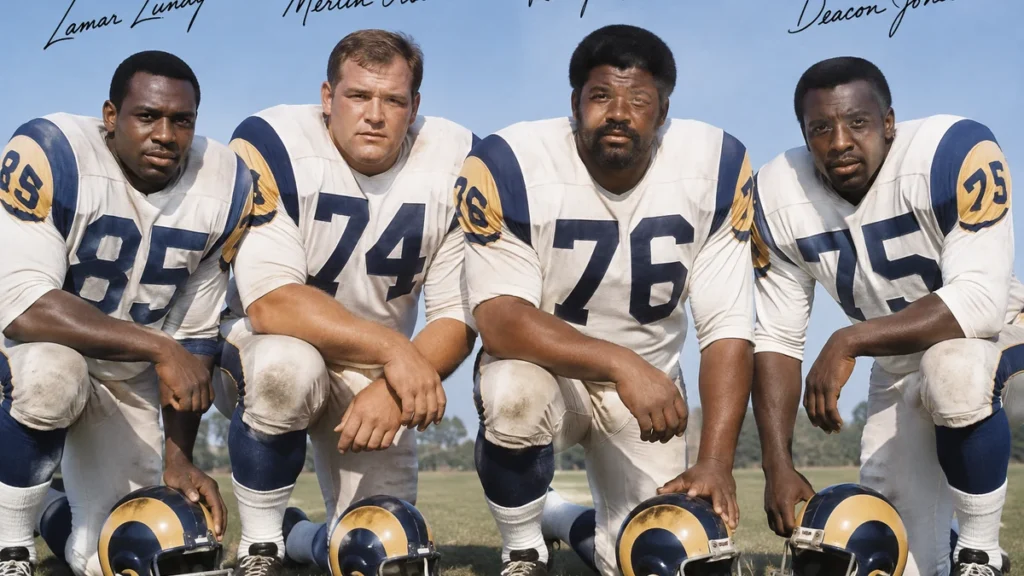
In Los Angeles he joined Deacon Jones, Merlin Olsen and Lamar Lundy. Sportswriters called them the Fearsome Foursome, and the name stuck so firmly that it became shorthand for any dominant defensive front. Dick Butkus, who had to play against them, described the group as the most dominant line in football history.
What made it work was balance. Jones was a pass rushing force. Olsen was a technician who went on to the Hall of Fame and then to television. Lundy was long and disruptive at end. Grier was the interior anchor who made the whole thing hold its shape.
A torn Achilles tendon ended his playing career. He last appeared in a regular season game in 1966, and the injury in 1967 closed the door for good. He is the last surviving member of the original four, following the death of Deacon Jones in 2013.
Rosey Grier NFL Career Summary
| Career Detail | Information |
|---|---|
| Draft | 1955, 3rd Round, 31st Overall |
| New York Giants | 1955 to 1962 |
| Los Angeles Rams | 1963 to 1966 |
| Games | 141 |
| Unofficial Sacks | 36.5 |
| Fumble Recoveries | 13 |
| Pro Bowls | 2 |
| NFL Championship | 1956 |
| Jersey Number | 76 |
What He Actually Achieved on the Field
Statistics from this era are incomplete, and it’s worth being careful here. Sacks were not an official statistic until 1982, so the numbers attached to his name are retrospective and unofficial.
The commonly cited career figures are 141 games, 36.5 unofficial sacks, 13 fumble recoveries and two safeties. He wore number 76 throughout.
His All-Pro total is where sources part company. Some list three selections, some four, and Wikipedia’s own tally of first and second team honours runs to six years. The difference comes down to which selectors are counted and whether second team picks are included. Two Pro Bowls and one NFL championship are not disputed.
He was a Pro Football Hall of Fame finalist in 1973 and appeared again among the 182 senior nominees for the class of 2025. He has not been inducted. The Giants named him to their Top 100 Players list, and the Rams placed him on their 40th Anniversary Team in 1985.
Rosey Grier and Robert F. Kennedy
This is the part of his life that pulled him into American political history.
After retiring he became a friend of Senator Robert F. Kennedy and worked security during the 1968 presidential campaign. On the night of 5 June 1968, at the Ambassador Hotel in Los Angeles, he was assigned to Ethel Kennedy, who was pregnant at the time.
He and Olympic decathlon champion Rafer Johnson heard shots ahead of them. Johnson reached the pantry first. When Grier arrived, Johnson and the writer George Plimpton were already grappling with Sirhan Sirhan. Grier joined in, took control of the revolver and helped subdue the gunman.
He has also described holding back the crowd afterwards. In his own account he refused to let the furious bystanders around him turn on Sirhan. That detail tends to get lost, and it says something about the man.
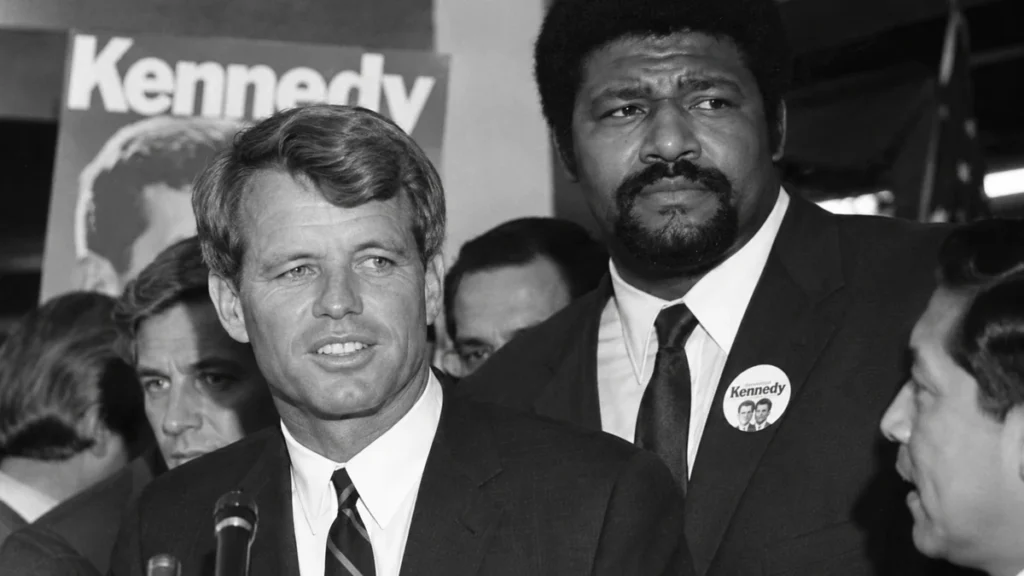
The connection ran deeper than one night. Later that year he recorded “People Make the World,” a Bobby Womack composition released as a tribute to Kennedy. He and his wife Margie named their son Roosevelt Kennedy Grier.
Rosey Grier’s Acting Career
He was one of the first football stars to move into acting and actually stay there. Studios and producers in Los Angeles had got to know him during his Rams years, and the offers arrived quickly once he stopped playing.
Across the 1960s and 1970s he made roughly 70 television appearances.
Movies
Verified film credits include The Desperate Mission (1969), Carter’s Army (1970), Skyjacked (1972), The Thing with Two Heads (1972), The Treasure of Jamaica Reef (1975) and The Glove (1979).
The Thing with Two Heads is the one that refuses to die. It is a low budget horror picture in which a bigoted white surgeon’s head is transplanted onto a Black man’s body. Grier plays the body. It was not prestige cinema and nobody pretends otherwise, but it has held on as a cult title for fifty years.
TV Shows
He joined Daniel Boone as a regular cast member from 1969, and also had regular roles on Make Room for Granddaddy and The White Shadow. In one White Shadow appearance he wore his old number 76 Rams jersey.
Guest credits include The Man from U.N.C.L.E. (1964), I Dream of Jeannie, The Wild Wild West (1967), McMillan and Wife (1974), Sesame Street (1975), Kojak, CHiPs (1977), The Love Boat (1979), Roots: The Next Generations (1979), The Seekers (1979), The Jeffersons (1983), The Larry Sanders Show (1998) and a voice role on The Simpsons in 1999. He appeared on Movin’ On with Claude Akins from 1974 to 1976, a series shot in his native Georgia. He also turned up as a panellist on Match Game in 1974.
The CHiPs appearance is a small classic. He plays a motorist who, during a routine traffic stop, calmly dismantles his own car with his hands.
Rosey Grier Movies and TV Shows
| Category | Notable Credits |
|---|---|
| Movies | The Desperate Mission, Carter’s Army, Skyjacked |
| Movie | The Thing with Two Heads |
| Movies | The Treasure of Jamaica Reef, The Glove |
| TV | Daniel Boone, Make Room for Granddaddy |
| TV | The White Shadow, Movin’ On |
| Guest Appearances | Kojak, CHiPs, The Love Boat |
| Guest Appearances | Roots: The Next Generations, The Jeffersons |
| Voice Role | The Simpsons |
The Rosey Grier Show
Between 1968 and 1970 he hosted a weekly half hour programme on KABC-TV in Los Angeles. It ran for three seasons and focused on community affairs rather than sport or celebrity.
The timing matters. This was Los Angeles a few years after Watts, and a Black former athlete hosting a local public affairs show was not a small thing.
Music and “It’s All Right to Cry”
He started releasing singles in 1960 and kept recording for around twenty five years across labels including Liberty, Ric, MGM and A&M. Only one of those records charted. “People Make the World,” the Kennedy tribute, reached number 128 in 1968.
Then came the song people actually remember.
In 1972 Marlo Thomas assembled Free to Be… You and Me, a children’s album built around the idea that kids should not be boxed in by gender expectations. Carol Hall wrote a track called “It’s All Right to Cry.” The producers wanted someone whose presence would make the message land, and they found him performing at the Playboy Club in Chicago.
The choice was deliberate to the point of being a little cheeky. Put the biggest, most physically imposing man available in front of a microphone and have him tell children that tears are fine.
According to Slate’s fortieth anniversary piece, Thomas wanted him to half speak the lyrics. He wanted to sing them properly, and he did. He also asked for drums to be added over the acoustic guitar.
The album became a bestseller, spawned a book and an Emmy and Peabody winning television special that aired in 1974, and the song has stayed in circulation ever since. Note that the title is officially “It’s All Right to Cry,” although it is very commonly written as “It’s Alright to Cry.”
Talking about it in his eighties, he was still visibly moved. He questioned what right anyone has to tell a small boy not to cry, pointing out that the hurt is the same either way.
Why Was Rosey Grier Famous for Needlepoint?
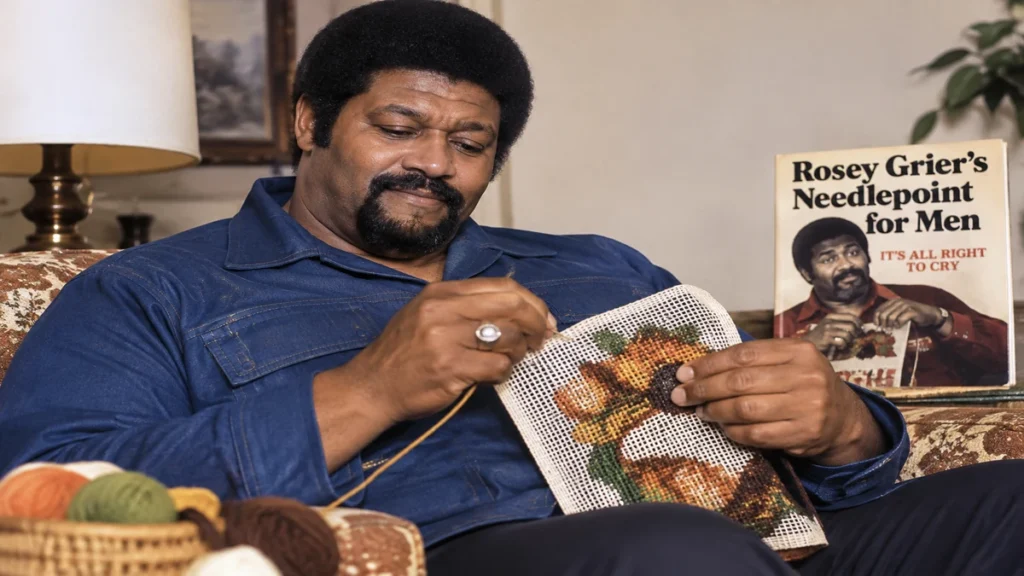
He became famous for needlepoint because he took it up seriously in the early 1970s, talked about it openly on television, and then published a how to book aimed squarely at men. At a moment when American culture was arguing loudly about gender roles, a 300 pound All-Pro lineman with an embroidery needle was an image nobody could ignore.
Honestly, this is the most unexpected part of the whole story, and it is the part competitors tend to mention in one line and move past.
Rosey Grier’s Needlepoint for Men
Walker and Company published Rosey Grier’s Needlepoint for Men in 1973. It runs to 158 pages and contains photographs, step by step instructions and patterns. The ISBN is 0802704212. Original copies now sell for serious money on the second hand market, which tells you something about how the book has been remembered.
The publisher’s jacket copy leaned into the joke, describing him as a tough cookie tackling the finer things in life. Underneath the wordplay there was a real argument. In a later interview with Bitch magazine he framed the book as an attempt to break down old ideas about what men were allowed to enjoy.
Read alongside “It’s All Right to Cry,” released a year earlier, the book stops looking like a novelty. The two projects make the same point in different formats.
Knitting, Crochet and Macrame
His interests went wider than needlepoint alone. He has also been documented as a crocheter, a knitter and a macrame enthusiast. Searches for “Rosey Grier knitting” and “Rosey Grier crochet” turn up plenty of results, and the underlying claim checks out. Needlepoint is simply the craft that got the book.
Ministry and Community Work
He was ordained as a Protestant minister in 1983. One source, BlackPast, places his ordination a decade earlier, in 1973, so the date is not perfectly settled, but 1983 is the figure most references give.
The following year he set up a nonprofit resource centre for inner city teenagers, offering spiritual and educational programmes. He is a cofounder of American Neighborhood Enterprises, which helps city residents buy homes and access vocational training. He later served as acting chairman of the board for Impact Urban America.
He sits on the board of trustees of the Milken Family Foundation and administers its community affairs programming. He has also given time to the Prostate Cancer Foundation, and he works as a motivational speaker.
The community work has been recognised locally rather than nationally. He has received commendations from the California State Assembly, the Los Angeles City Council and former Los Angeles mayor Tom Bradley.
Wife, Marriages and Children
Search interest in his wife and family is high, so here is the documented picture.
He has a daughter, Sherryl Brown-Tubbs, from an early relationship. He married Beatrice Lewis in 1962 and adopted her daughter, Denise. That marriage ended in divorce in 1970. Some sources give her name as Bernice rather than Beatrice.
He married Margie Grier, born Margie Lou Hanson in Pasadena, California, in 1973. Their son Roosevelt Kennedy Grier was born in 1972. The couple divorced in 1978, remarried in 1981, and stayed together until her death on 10 June 2011.
On 30 April 2013 he married Cydnee Seyler, a schoolteacher from Wichita, Kansas.
One more family connection is worth mentioning. His nephew Mike Grier played fourteen seasons in the NHL and later became the first Black general manager in league history, with the San Jose Sharks.
Books Written by Rosey Grier
| Year | Book |
|---|---|
| 1973 | Rosey Grier’s Needlepoint for Men |
| 1986 | Rosey, an Autobiography: The Gentle Giant |
| 1990 | Winning |
| 1993 | Rosey Grier’s All American Heroes: Multicultural Success Stories |
| 1993 | Shooting Star |
| 2018 | Life Through Rosey Colored Glasses |
Political Life
His politics moved over time, and the record is clearer than most summaries suggest.
He campaigned for Democrats for much of his early public life. He appeared at Democratic National Conventions, including Chicago in 1968 and Madison Square Garden in 1980, and took part in a Democratic fundraiser broadcast in 1973.
By the early 1980s he had become a Republican. According to BlackPast, his views on abortion and school prayer drove the shift. On 20 August 1984 he spoke at the Republican National Convention in Dallas and endorsed Ronald Reagan for re-election.
On 5 January 2017 he announced that he would run for governor of California as a Republican in the 2018 election. He withdrew from the race that July.
Rosey Grier Net Worth
Several celebrity finance sites estimate his net worth at around 5 million dollars. Celebrity Net Worth is the most widely cited of these. Other sites have published figures above 6 million.
Treat all of those numbers as estimates rather than facts.
That’s where things get a little more complicated. None of these sites explain their methodology, none cite financial disclosures, and no verified public record confirms any figure. His playing career ran through the 1950s and 1960s, when NFL salaries were a tiny fraction of modern pay, so wealth built purely from football is implausible. Acting, books, speaking fees and ministry work all followed. Beyond that, publicly available records do not confirm a total.
Anyone stating a precise number as fact is guessing.
Where This Story Touches American History
The geography of his life maps neatly onto the twentieth century American story.
Cuthbert, Georgia, is where it starts, on a farm in the segregated rural South. Roselle, New Jersey, is where the family landed during the Great Migration, and where school and sport became available to him. Pennsylvania, at Penn State, is where he played college football and track during the early years of desegregation in college athletics.
New York gave him a championship and eight seasons with the Giants. Los Angeles gave him the Fearsome Foursome, a television career, a local talk show, the Ambassador Hotel on the worst night of 1968, and the community work that has occupied him since.
There is one more stop. In December 1968 he joined Bob Hope’s USO Christmas tour, performing for troops in Vietnam, Thailand, South Korea and Guam.
What Makes This Life So Unusual
Plenty of athletes have second acts. Broadcasting, coaching, business, occasionally politics. What’s fascinating here is the contrast between the acts.
The transition worked partly because he never treated the crafts as a gimmick. He learned needlepoint properly, wrote a technical book about it, and defended the idea in interviews for decades. The same is true of the Music, which he pursued across twenty five years and several labels rather than as a one off novelty.
There’s an important distinction to draw as well. The needlepoint made him famous in a new way, but it did not replace the football reputation. Both have survived. People arriving from Free to Be… You and Me are often surprised to learn he was an All-Pro lineman. People arriving from NFL history are often surprised by the needle.
A common misconception is that he was primarily a celebrity who happened to play football. He was a genuinely serious player who started every game he appeared in and won a championship. Another is that he was Robert Kennedy’s official bodyguard. He was a friend and volunteer security presence during the campaign, assigned that night to Ethel Kennedy rather than the senator.
The Legacy, in Several Parts
His legacy sits in several places at once, which is exactly why it is hard to summarise.
In football, he is remembered as the anchor of the original Fearsome Foursome and a key part of a Giants defence that changed how the sport thought about defensive units. He is not in the Hall of Fame, and reasonable people disagree about whether he should be.
In entertainment, he is one of the earliest examples of an athlete building a durable second career on screen rather than a handful of cameos.
In culture, the needlepoint book and “It’s All Right to Cry” made him an unlikely early voice in an argument about masculinity that is still going on. Neither was an accident.
In his communities, the ministry, the nonprofits and the youth work have taken up more of his life than football ever did. He was ordained more than forty years ago. He played professionally for about twelve.
Sports Illustrated reported in 2025 that he is the oldest living former NFL player. He was still alive as of September 2026, aged 94.
FAQs
Who was Rosey Grier?
He is an American former NFL defensive tackle, actor, singer, author and ordained minister, born in 1932 in Cuthbert, Georgia.
What was Rosey Grier famous for?
Football first, through the New York Giants and the Los Angeles Rams’ Fearsome Foursome. Later for acting, for singing “It’s All Right to Cry,” for promoting needlepoint to men, and for helping subdue Robert F. Kennedy’s assassin.
What NFL teams did Rosey Grier play for?
Two. The New York Giants from 1955 to 1962 and the Los Angeles Rams from 1963 to 1966.
Was Rosey Grier part of the Fearsome Foursome?
Yes. He lined up alongside Deacon Jones, Merlin Olsen and Lamar Lundy in the original Rams group. He is the last surviving member.
How many Pro Bowls did Rosey Grier make?
Two, in 1956 and 1960. Both came while he was with the Giants.
Did Rosey Grier win a championship?
Yes, the 1956 NFL Championship with the Giants. His career ended before the first Super Bowl, so he never played in one.
What movies and TV shows was Rosey Grier in?
Films include Skyjacked, The Thing with Two Heads, Carter’s Army and The Glove. He had regular roles on Daniel Boone, Make Room for Granddaddy, Movin’ On and The White Shadow, plus guest spots on Kojak, CHiPs, The Love Boat, Roots: The Next Generations, The Jeffersons and The Simpsons.
Who was Rosey Grier’s wife?
He has been married to Cydnee Seyler since 2013. He was previously married to Margie Grier, who died in 2011, and before that to Beatrice Lewis.
How many children did Rosey Grier have?
Documented children are a daughter, Sherryl Brown-Tubbs, an adopted daughter, Denise, and a son, Roosevelt Kennedy Grier, born in 1972.
What is Rosey Grier’s net worth?
Celebrity finance sites commonly estimate around 5 million dollars. No verified public record confirms this, so it should be read as an estimate.
Why was Rosey Grier famous for needlepoint?
Because he took it up in the early 1970s, spoke about it openly, and published a book teaching it to men in 1973. The contrast with his size and profession made it national news.
Did Rosey Grier write Needlepoint for Men?
Yes. Rosey Grier’s Needlepoint for Men was published by Walker and Company in 1973.
Did Rosey Grier sing “It’s Alright to Cry”?
Yes, although the official title is “It’s All Right to Cry.” He recorded it for Marlo Thomas’s 1972 album Free to Be… You and Me, and it later featured in the television special.
What was Rosey Grier’s connection to Robert F. Kennedy?
He was a friend who worked security on Kennedy’s 1968 presidential campaign. He was guarding Ethel Kennedy on the night of the assassination and helped take the gun from Sirhan Sirhan.
Was Rosey Grier a minister?
Yes. He was ordained as a Protestant minister, most sources say in 1983, and has spent decades in ministry and youth work.
Is Rosey Grier still alive?
Yes. He turned 94 in July 2026 and has been described as the oldest living former NFL player.
A Closing Thought
Reduce this life to football and you lose most of it.
The football was real and it was good. Championship ring, Pro Bowls, and a defensive line people still argue about them But it occupied roughly twelve years of a life that has now run more than ninety.
What came afterwards was stranger and, arguably, more consequential. A local talk show in a city still working through its own divisions. A song that gave a generation of children permission to feel something. A craft book that quietly picked a fight with an entire set of assumptions about men. A night in a hotel pantry that put him into the footnotes of American political history. And forty plus years of ministry that almost nobody outside those communities writes about.
Look at what happened next, over and over, and a pattern emerges. He kept refusing to stay in the box people built for him.
If this kind of story interests you, there is plenty more to explore in the history of American football’s pre Super Bowl era, in the crossover between sport and 1970s television, and in the lives of the other athletes who found second careers on screen.